
Ask ten car owners what the clutch does and most will say “it helps me change gears.” Fair enough, but there’s a bit more going on. The clutch is what lets the engine keep running while the car stands still at a signal, and it’s also what takes the car off smoothly when the light turns green. Every single time. In city traffic, that’s hundreds of times a day.
So it’s no surprise that it gives up eventually. The real problem is when people notice the signs and carry on anyway. A small clutch issue left for a few months can end up as a gearbox job, and that bill is a very different story. Doctor Garage sees this often, and most of it could have been avoided with an earlier check.
Clutch Function in a Car: 6 Things You Should Know
Simple version: press the pedal and the engine stops pushing power to the gearbox. That’s your window to change gear. Release the pedal and the power goes back to the wheels.
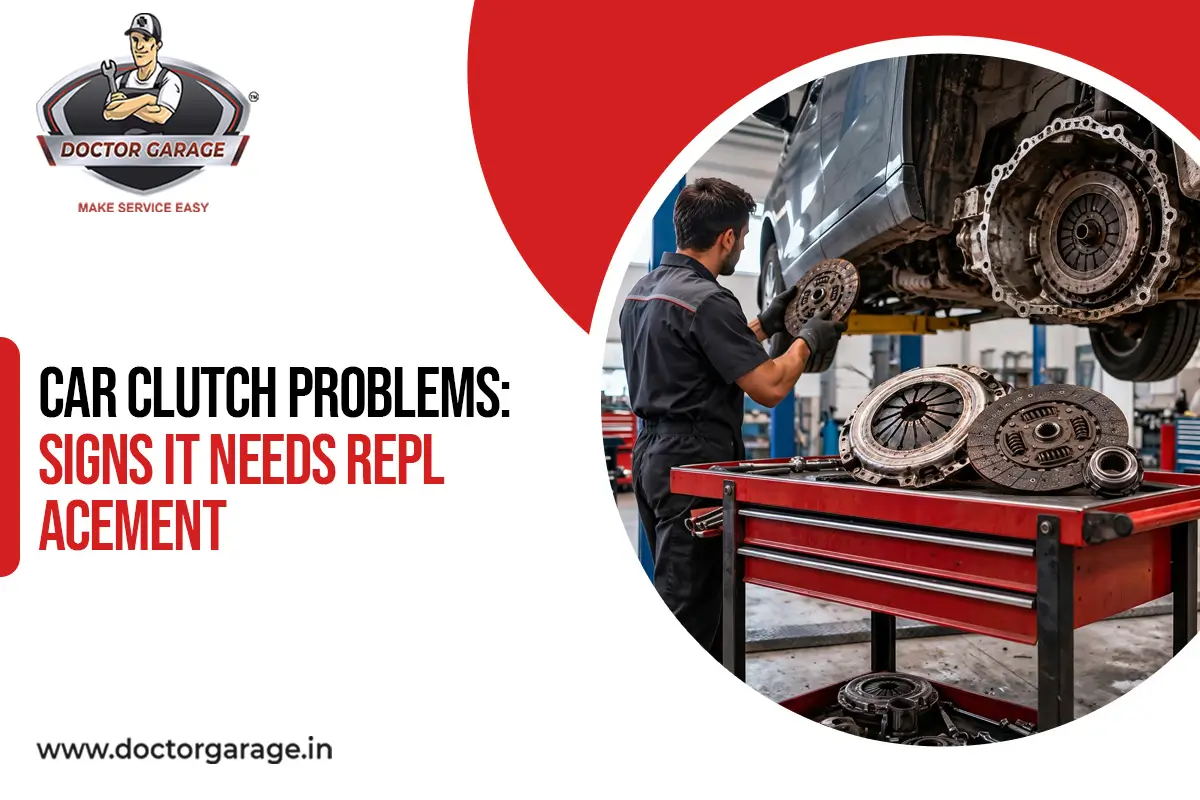
Inside, you’ve got the clutch disc, the pressure plate and the release bearing doing the main work. Some cars also bring in a flywheel, a cable or a hydraulic setup, which is where a lot of the odd problems come from.
None of it lasts forever. Heavy traffic, a loaded boot, a lead foot, all of it counts towards how quickly it goes.
Read: Why Is My Car AC Not Cooling Properly: Common Causes and Fixes
1. Clutch Slipping While Driving
You press the accelerator and the engine sounds louder, but the car doesn’t speed up. It feels like pedalling a cycle with a loose chain.
The disc has stopped gripping properly. Usually it’s simply worn out, but oil getting onto it or a tired pressure plate can cause the same thing.
Try an uphill road or a full car and it gets obvious. Ignore it and the heat keeps building inside, which makes things worse each day.
2. Difficulty Changing Gears
First gear won’t go in. The reverse makes a grinding sound. It happens, and people often blame the gearbox right away.
But quite often the clutch isn’t disengaging fully. Low hydraulic fluid, air in the line or a faulty clutch master or slave cylinder can all cause this, and none of them involve the clutch disc.
Never force the gear lever when it resists. Forcing it can damage the gearbox, and then a clutch problem becomes a gearbox problem too.
3. Unusual Noise When Pressing the Clutch
A squeal, a chirp, a grinding sound, sometimes a rattle. If it shows up only when you push the pedal down, the release bearing is high on the list.
Listen to when it happens, because that tells the mechanic a lot. Stay on after you let go? Different story.
And please don’t order parts based on a sound you heard. Get someone to actually look.
4. Clutch Pedal Feels Different
You use that pedal every day, so you know how it normally feels. Then one morning it’s spongy. Or heavy. Or it doesn’t come back up the way it used to.
Soft usually hints at hydraulics. Heavy can be the mechanism itself. A pedal that stays near the floor needs attention fast, since it can leave you stuck without warning.
5. Burning Smell After Driving
Sit in a long jam, or crawl up a flyover with the clutch half pressed, and you may get a sharp burnt smell. That’s clutch cooking.
Holding the car on a slope with the clutch instead of the brake is the most common cause. A lot of drivers do this without realizing it.
One whiff, fine. Every other drive? Something’s off, and it will shorten the clutch’s life if you let it continue.
6. Car Shudders When Moving Off
You lift the clutch and the whole car shakes for a second before moving. Some people think it’s their technique. Sometimes it is, but when it keeps happening, it usually isn’t.
Uneven wear on the disc, contamination, a flywheel problem or a faulty pressure plate can be behind it. You’ll notice it mainly when starting from a dead stop.
When Does a Clutch Need Replacement?
Nobody can give you one kilometre figure that fits every car. It depends on the car, the roads, how you drive and what you carry.
Stop-and-go driving wears it out faster. So does resting your foot on the pedal, or holding the car on a hill with it.
If you’re getting more than one sign together, say slipping plus a burning smell plus hard shifts, don’t wait. For dependable car service in vadodara, a proper inspection will show whether you need an adjustment, a repair or a full replacement.
Clutch Repair or Complete Replacement?
Not every clutch complaint means a new clutch. Could be a hydraulic leak. Could be a worn linkage or just a bad adjustment.
That said, if the disc is properly worn out, patching one part rarely holds up. This is why mechanics look at the disc, pressure plate, release bearing and flywheel as a set.
Doctor Garage works on diagnosis first. Find the cause, then fix it. You don’t end up paying for parts that were never the problem. This honest, check-before-you-replace approach is also why many business-minded people look at a four-wheeler service franchise with the brand.
How Can You Extend Clutch Life?
You can’t stop normal wear, but these help:
- Take your foot off the pedal while driving.
- Don’t hold the car on a slope with the clutch.
- Use the handbrake at slopes and signals.
- Cut down on half-clutch driving.
- Pick the gear that suits the road and speed.
- Don’t ignore small changes in how the clutch behaves.
- If it’s already slipping, go easy on the accelerator.
Bikes have clutches too, and the same habits apply there. Riders who take care of the clutch lever early save a lot of trouble later. If you’re someone who enjoys this side of vehicle care and wants to build a business around it, a 2 wheeler service franchise is worth a look.
Why Early Clutch Inspection Matters
A bad clutch affects pick-up, gear changes and how comfortable the car feels. At the extreme, it stops sending power to the wheels and the car can’t move at all. Not fun on a busy road.
Catch it early and you’ve got choices. It may turn out to be minor. If it needs replacing, at least nothing else got damaged while you kept driving.
Looking for reliable car repair service in vadodara? Ask the workshop one thing before you hand over the keys: will they check the full clutch system, or only the part you complained about?
Don’t Wait Until Your Car Refuses to Move
Slipping, a weird noise, a burnt smell, a gear that won’t go in. Each one is the car trying to tell you something. If you listen now, it’s often a small job. If you don’t, you could end up stuck at a signal with a car that won’t budge.
And if you’re reading this as a business owner, say someone exploring an automobile dealership opportunity in Nagpur, remember that service is what keeps customers coming back long after the sale. A workshop that diagnoses honestly builds that trust.
At Doctor Garage, the team checks the whole clutch system and tells you what’s wrong before touching any part. If your clutch has started acting up, book an inspection with Doctor Garage today and sort it out before it gets bigger.
Frequently Asked Questions (FAQ)
It depends on who’s driving. Some people get 80,000 km or more out of one, and others are back at the workshop before 40,000. If you drive in the city, in traffic every day, it’ll go sooner than a highway car. Nobody can promise a number.
Short trips to the workshop, fine. Beyond that, it keeps getting hotter inside, and the flywheel and pressure plate start suffering too. People often put it off for a month and then find the bill has doubled.
Tough one, even for drivers who know their car. Revs going up without the car picking up speed, a burnt smell or a pedal that feels strange usually means the clutch. If gears grind even when you’ve pressed the pedal fully, the gearbox may be involved. A mechanic will know after one test drive.
Varies with the car and the kit. Labour is a big part of it, since the gearbox has to come out to reach the clutch. If the flywheel or slave cylinder needs changing, add that on top. Get a written estimate after they’ve opened it up.
A lot, yes. Resting your foot on the pedal, creeping on a slope with the clutch half pressed, revving hard while it slips: all of that wears the disc faster. Use the handbrake at signals and you’ll see the difference in a year or two.
Not always. Once the clutch is off, the flywheel gets a proper look. Light wear can usually be skimmed (resurfaced). Cracks, deep grooves or blue heat marks mean a new one.