
Quick Answer: For a bike service franchise to succeed, hire mechanics who pass a practical test, train them on a fixed service process, use job cards and checklists, and keep them with fair pay and growth. These eight steps below show you how.
Before opening a bike service franchise, most people spend weeks choosing a location and shopping for equipment. Both matter. But walk into any busy workshop and watch who the customer talks to when collecting the bike. It is the mechanic.
If the work is careless, even a well-equipped workshop faces repeat repairs, complaints and delays. So if a two wheeler service franchise is on your mind, think about your team from day one. Doctor Garage understands how much a trained technician and a steady workshop routine help a service business stay profitable.
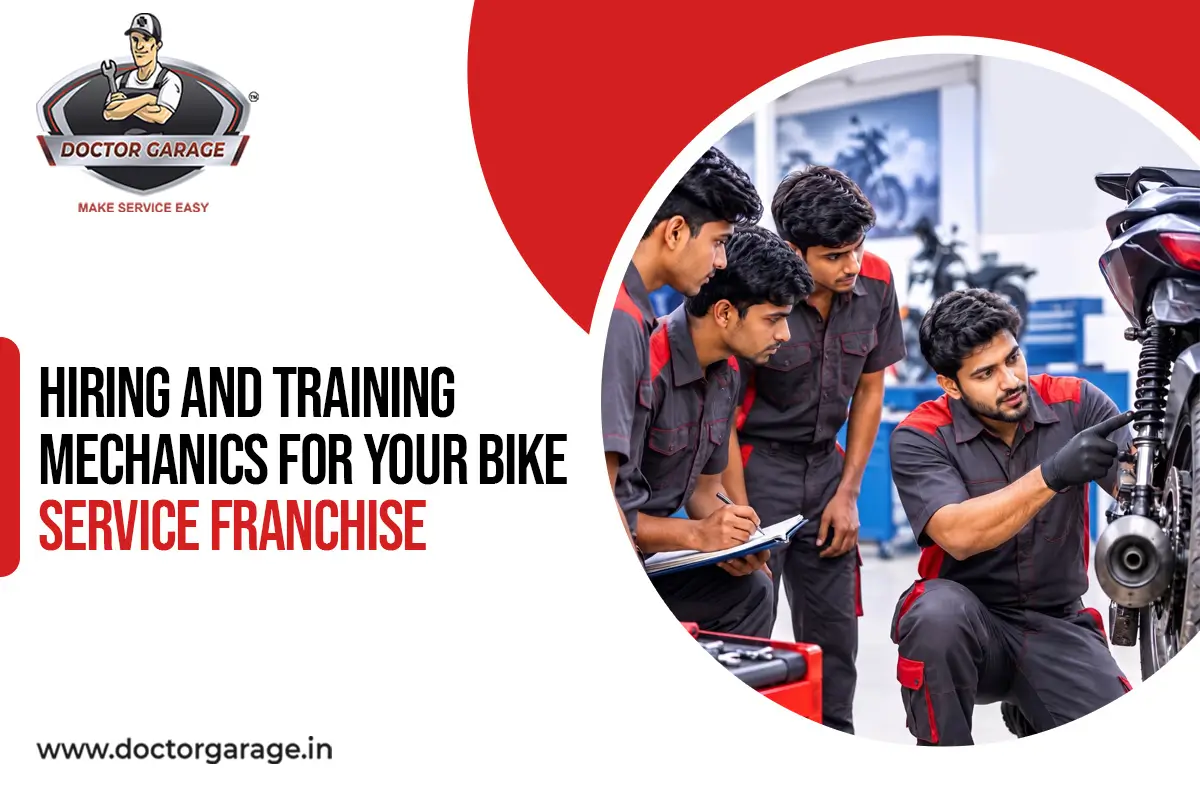
8 Ways to Build a Trained Team for Your Auto Garage Franchise
1. Work Out How Many Mechanics You Need
Be clear about what your workshop will handle. A small centre doing oil changes, brake checks, chain adjustments and general repairs needs a few all-rounders. A bigger bike service centre that also handles electrical faults, fuel injection and engine diagnostics needs a couple of people with deeper skills.
Then look at your daily numbers. If you expect 15 to 20 routine services a day, you will need more general technicians than diagnostic specialists in the first few months. Hire specialists once harder jobs actually start coming in.
Give everyone a clear role too. When nobody owns the brake check, everyone assumes someone else did it. Clear roles also make salary planning easier.
2. Hire Mechanics with the Right Skills
Experience helps, but it is not everything. A mechanic with ten years behind him who cuts corners can be worse than a keen learner with two. Judge attitude as much as the CV.
An ITI (Motor Cycle Mechanic) certificate or any automotive training is a good base, but it does not prove he can fix a bike. Test it. Give the candidate a motorcycle and ask him to do a basic inspection, find a simple fault, or explain how he would handle a brake complaint. Ten minutes is enough to know who understands the work.
Do not skip communication either. A mechanic must explain a problem in plain Hindi or English, or the local language, and avoid pushing repairs the customer does not need. Mechanics who speak respectfully are the ones who bring customers back.
3. Create a Structured Bike Mechanic Training Programme
Even a skilled hire needs training when he joins a new workshop. Every workshop has its own inspection routine, paperwork and way of dealing with customers.
A good programme covers:
- Routine servicing and preventive maintenance
- Brake, clutch, chain and tyre checks
- Engine and electrical troubleshooting
- Safe handling of tools and equipment
- Job cards and service records
- Final quality checks before delivery
- Customer communication and honest repair suggestions
Do not just tell trainees what to do. Let a senior technician do the job while they watch, then let them do it with the senior standing beside them. People remember what they have done with their hands.
If you are exploring a 2 wheeler service franchise in Bhopal, or in cities like Indore, Lucknow, Jaipur or Nagpur, this kind of training helps you maintain the same standard from day one, whoever you hire.
4. Standardise Service Procedures Across the Workshop
Without a fixed routine, one mechanic does a thorough service and the next skips half the checks. The customer cannot tell the difference at pickup, but finds out a week later.
Make simple checklists for engine oil change, brake inspection, tyre condition, battery, chain adjustment and a final road test before delivery. Keep them short enough that the team actually uses them.
Every bike should also have a job card recording the complaint, the mechanic’s findings, what the customer approved, parts replaced and work done. Someone must verify the work against the card before the bike is handed over.
Some brands offering an auto garage franchise provide ready procedures and training. Ask exactly what you will get. Is there hands-on technician training? Refresher sessions? Ongoing field support? Do not settle for a vague “yes, we support you.”
5. Invest in Continuous Learning
Bikes are not what they were ten years ago. Fuel injection, sensors, ECUs, ABS and complex wiring are now common, and BS6 models need different diagnosis than old carburettor bikes. A mechanic who only knows the old way will struggle.
Run regular sessions on updated diagnostic methods, new tools and changes in manufacturer procedures. These need not be fancy. A senior technician explaining a tricky repair, or a team discussion on last month’s mistakes, works well.
Let people ask questions. If a mechanic is afraid to say “I have not seen this fault before,” he will guess, and guessing on brakes or electricals is how accidents happen.
When comparing the best franchise business in India, ask how the brand keeps its technicians updated. A model that invests in learning is likelier to hold its quality as vehicles change.
6. Retain Skilled Mechanics with a Supportive Workplace
Hiring and training cost time and money. If a trained mechanic leaves for a few thousand rupees more elsewhere, you start over, and regular customers notice the missing face.
What keeps people? Fair and on-time salary, clear responsibilities, a safe workshop, and a path to grow into senior technician or supervisor. Incentives help, but only when they reward quality and customer satisfaction. If they reward speed alone, mechanics will rush.
Notice who maintains standards, helps juniors and handles problems honestly. A short feedback chat now and then reveals training gaps before they grow. And do not overload people. A tired mechanic makes mistakes.
7. Measure Training and Workshop Performance
Training means little if nothing improves. Track a few simple numbers:
- Repeat repairs
- Customer complaints
- Time taken per service
- Inspection accuracy
- Customer feedback and Google reviews
- Checklist and job card compliance
If repeat repairs go up, find out why before blaming anyone. Is it wrong diagnosis, weak training, poor spare parts or unclear steps? Fix the real cause.
When estimating the most profitable franchise in India, remember profit is not just footfall. Labour cost, repeat business, spare parts management, repair quality and staff retention all shape what you finally earn.
8. Build a Skilled Team with Doctor Garage
A good bike service business rests on three things: technical knowledge, a consistent process and honest dealing with customers. Doctor Garage builds its two-wheeler service model around these.
If you are considering an automobile service business, ask how the franchise supports hiring, mechanic training, daily workshop operations and technical development over time. The answers show whether the model suits your goals and your local market.
And if you are comparing a low cost franchise in India, do not let a lower price mean weaker mechanics, an unsafe workshop or poor service. Add up the full cost, including training, tools, staff salaries and working capital, before you decide.
Conclusion
A good mechanic can walk into your workshop on day one. The harder job is what comes next: showing him how you want things done, giving the whole team the same checklist, and making sure he is still there next year. Do that, and customers will start asking for your workshop by name.
Thinking of starting your own two wheeler service workshop? Speak to Doctor Garage. Find out about franchise opportunities, the training and support you would receive, and the first steps to take.
Frequently Asked Questions (FAQ)
There is no fixed number. A workshop handling around ten bikes a day, mostly routine servicing, can run with three or four people. If you add electrical or engine work, you will want one or two who can diagnose properly. Start small, watch the bay for a month, then hire more.
It varies by city, skill and experience. Freshers in smaller cities typically start at a lower monthly salary, while experienced diagnostic technicians in metros earn noticeably more. Check current local rates before budgeting, and plan for incentives and annual increments.
A bit of both. The experienced mechanic saves you from costly mistakes. The fresher costs less and picks up your way of working, though he needs a senior beside him for the first few weeks.
Basic servicing first, then brakes, clutch and chain work, followed by electrical faults and fuel injection. Also teach him to fill a job card and explain a problem to the customer without jargon. This last part is often skipped.
Usually it is late salary, no growth, or too much work on one person. Fix those three and most of the problem goes away. A word of thanks for a job well done costs nothing.
Yes. Without them, one mechanic checks the brake pads and another does not. A checklist on the wall ensures every bike gets the same checks.
Ask about total investment, technician training, tools and spare parts supply, brand support, and expected working capital. Get everything in writing.